




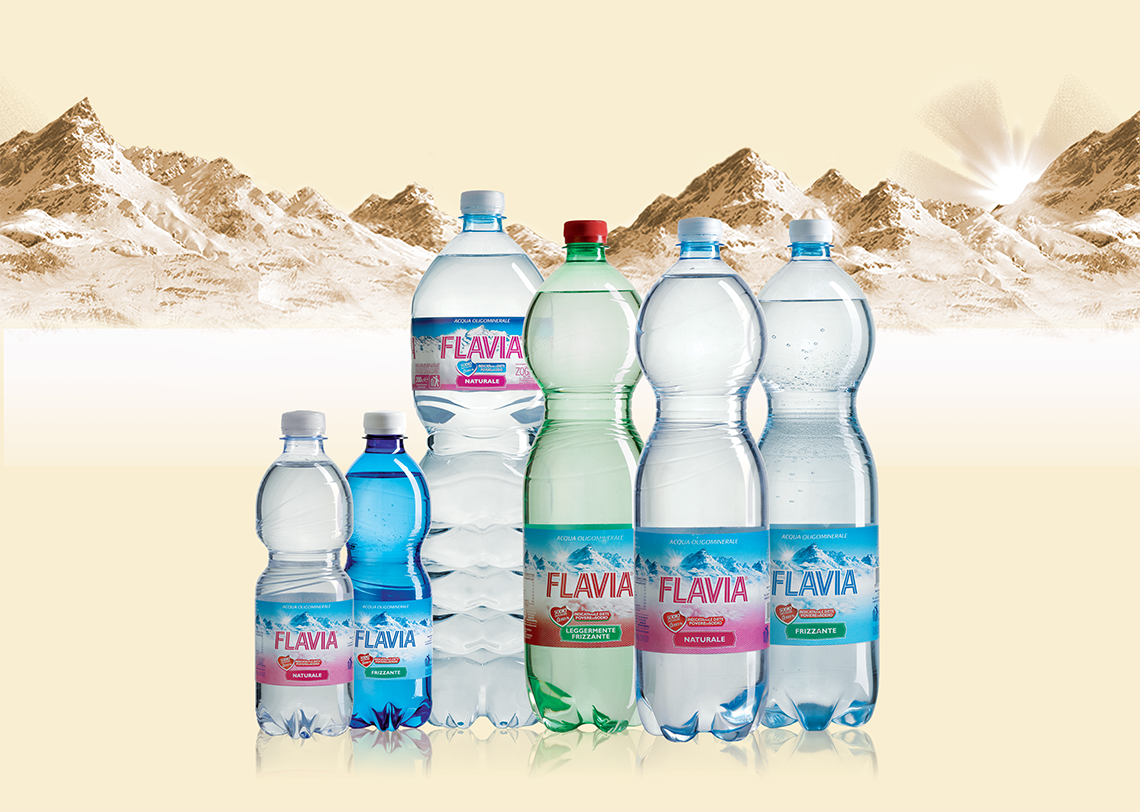
Flavia water was discovered in the winter of 1962; the natural environment, in the middle of the woods and without any possibility of civil and industrial settlement, represented a guarantee for the quality of the spring water.
Flavia water is characterized by the low presence of dissolved sodium and it is indicated for feeding babies.
| Chemical-physical properties | Dissolved substances in mg/l | ||
| pH of the water at the source | 7,6 | Nitrate | 1,6 |
| Specific eletric conductivity at 20°C | 424 μS/cm | Sodium | 0,7 |
| Residue at 180°C | 263 mg/l | Chlorine | 0,7 |
| Free carbon dioxine a the source | 15,0 mg/l | Magnesium | 27,0 |
| Water temperature at source | 12,6 °C | Calcio | 61,3 |
| Sulphate | 25,9 | ||
| Hydrogen carbonate | 286,0 | ||
| Format | cl | Ean Code |
| Natural Flavia pet | 150 | 8002453123024 |
| Sparkling Flavia pet | 150 | 8002453123017 |
| Lightly sparkling Flavia pet | 150 | 8002453123031 |
| Natural Flavia pet | 200 | 8002453164027 |
| Format | cl | Weight |
| Flavia pet | 150 | 1,54 Kg |
| Flavia pet | 200 | 2,04 Kg |
| Bundle of 6 bottles | 150 | 9,45 Kg |
| Bundle of 6 bottles | 200 | 12,30 Kg |
| Epal pallet of 84 bundles x 6 bottles | 150 | 812,00 Kg |
| Epal pallet of a 76 bundles x 6 bottles | 200 | 955,00 Kg |
